






“Bigger is better” epitomizes a significant cultural sentiment in America. This notion resonates profoundly every Sunday during America’s favorite sport.
While size might not directly translate into skill on the football field, it undeniably influences evaluations. Most position archetypes lean toward size outliers: Calvin Johnson (6-foot-5, 237 pounds) at wide receiver, Jonathan Ogden (6-foot-9, 345 pounds) at offensive tackle, and Kyle Hamilton (6-foot-4, 220 pounds) at safety. The assumption tends to be that larger players carry inherent advantages, but is there such a thing as too much size?
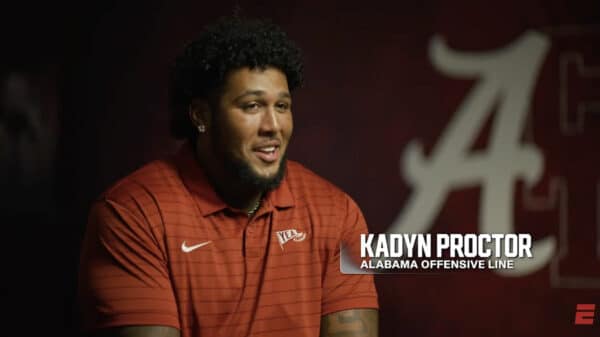
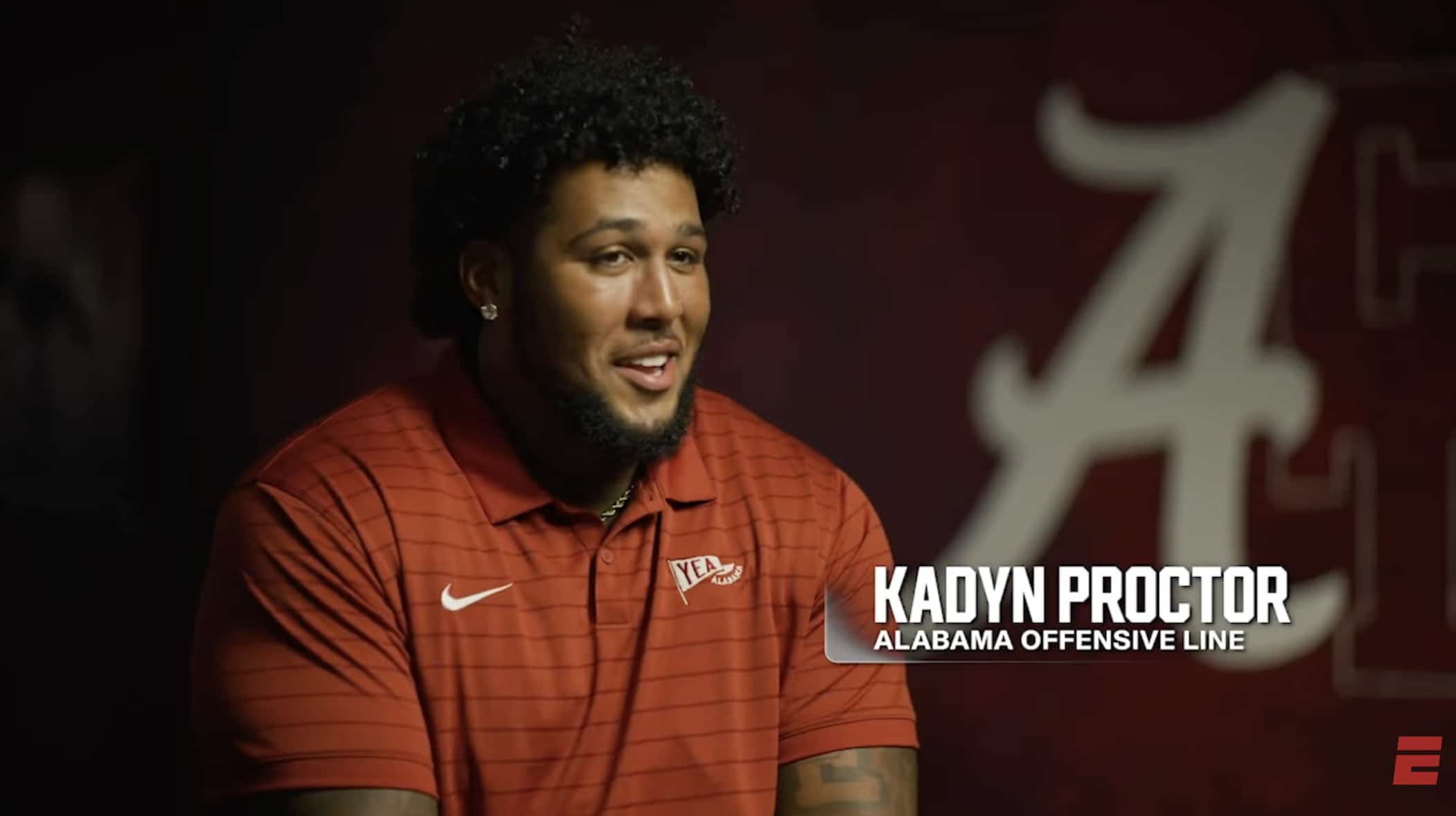
This question is particularly pertinent for NFL general managers considering Alabama tackle prospect Kadyn Proctor. He is an impressively large individual, standing at 6-foot-6⅝ and weighing in at 352 pounds. The true junior reportedly has 274 pounds of lean muscle mass, which makes it nearly impossible for him to drop into the 300-pound range—there simply isn’t enough excess weight to shed. Proctor, at just 20 years old, has already undergone significant weight loss, transitioning from closer to 400 pounds when he arrived in Tuscaloosa.
To evaluate Proctor’s performance properly, we will first explore how his substantial frame aids him on the field. Following that, we will address potential drawbacks this size may present, ultimately examining how his film compares to historical precedents of offensive tackles within his weight category.
Proctor’s size as a clear advantage on film
The benefits of Proctor’s size are immediately evident on tape. His strength at his age is remarkable, demonstrated through his ability to neutralize defenders outside of his body dimensions. He can effectively halt a slanting defensive end using little more than an extended arm. His capacity to absorb power without yielding ground stands out greatly. This attribute creates larger pockets for quarterbacks, providing an advantage over lighter offensive tackles who may not have the same consistency in this regard.
In run scenarios, Proctor excels at generating movement, especially on double teams. When paired with Tyler Booker in 2024, they routinely moved 3-technique defenders five yards off the line of scrimmage. The exciting aspect is that, given his age, considerable growth in strength is plausible moving forward.
The potential downsides of extreme size
Although strength provides substantial advantages, the added weight also introduces several challenges for an offensive lineman. Note that speed—or lack thereof—becomes a major concern, affecting both footwork and hand movement. In the equation of Force = Mass x Acceleration, the need for acceleration diminishes as mass increases. Moving 352 pounds demands greater effort than handling 310 pounds.
This is why elite pass protectors mirroring edge rushers clocking 4.4 seconds in the 40-yard dash often resemble players like Joe Thomas rather than Jordan Mailata. That critical fraction-of-a-second difference in foot speed and hand quickness can be the game-winner. This is especially noticeable when Proctor is tasked with plays in open space. He has experienced misses on linebackers and defensive backs positioned out wide.
Insights from history regarding 350-plus-pound offensive tackles
An additional, subtler concern about excessive weight pertains to what it signifies. Yes, larger players do exist, but almost all could attain a playing weight closer to 330 if they choose. Poor weight management may indicate bad habits. This isn’t an absolute rule, yet it certainly proved true in the case of Isaiah Wilson, who emerged from Georgia.
Wilson is one of ten tackles over the past 15 years who weighed in at over 350 pounds at the NFL Scouting Combine:
Diving into that list, there are examples that speak positively for Proctor’s draft outlook:
- Trent Brown held the title of the highest-paid tackle in the NFL at one point.
- Dawand Jones transitioned smoothly into a starter as a fourth-round pick.
- Jordan Mailata ranks among the league’s top tackles.
- Mekhi Becton showcased stellar performance as a rookie before suffering a severe knee injury.
- Orlando Brown Jr. has established himself as a reliable starter across three different teams.
- Amarius Mims rectified the Bengals’ tackle challenges in his second NFL season.
On the flip side, the “misses” on that list include a player whose film did not impress from the start (Daniel Faalele), a developmental project who lacked game experience (Giovanni Manu), and a player who controversially stepped away from football (Isaiah Wilson).
What potentially complicates Proctor’s situation is the program he came from. Alabama has produced two offensive tackles picked in the top 15 over the last five years. Both weighed over 350 pounds in college and struggled transitioning to the NFL. Evan Neal (337 pounds at the combine) is regarded as one of the biggest draft disappointments, while JC Latham (342 pounds at the combine) is already being considered for a conversion to guard in his third professional year.
This narrative unfairly simplifies the complexities. Proctor played in a more pass-oriented system under Kalen DeBoer, which frequently tested his protection skills. His film displays superior performance, particularly regarding balance.
One unfortunate aspect of carrying such substantial upper-body weight is that a player’s center of gravity can drift over their base, increasing the risk of falling. Proctor very rarely finds himself on the ground in his tape. Neal struggled mightily in this regard at Alabama, and the situation only escalated in the NFL. Latham was marginally better than Neal in maintaining his balance but still not at Proctor’s level. Balance is vital for a tackle, and Proctor has evidenced commendable ability in that area.
Understanding Proctor in the context of the NFL
As with all NFL prospects, each individual presents unique qualities. Trends can provide insights, but evaluators must analyze each athlete’s strengths and weaknesses contextualizing the current trends. In Proctor’s case, there are several compelling reasons to have faith in his potential for success at the professional level.
Proctor’s youth, the improvement displayed on tape, and his elite attributes position him with the highest potential among offensive tackle prospects. Thus, he stands as my top-ranked player at the position and the fourth overall.
At a position driven largely by physical traits, Proctor possesses all the makings of an All-Pro in the NFL. While not all players fulfill their potential, Proctor’s upside is certainly worthy of investment.
Kadyn Proctor NFL Draft profile and scouting report
Kadyn Proctor exemplifies the enormous physique of a dominant left tackle, seamlessly combining rare size with agility typically associated with smaller players. An exceptionally talented athlete, he has even assumed roles as a wide receiver and running back in goal-line scenarios, reflecting his unique versatility. While he excels in the run game, consistently moving defenders at the point of attack, he continues to enhance his technique in pass protection. Improvements were noticeable throughout the 2025 campaign. Although he may initially transition to guard professionally, his remarkable potential and natural talents make him a cornerstone prospect.
About
- Statistics: Five sacks, 36 pressures allowed over the last two seasons (12 sacks, 36 pressures as a freshman in 2023)
- 2025: Selected as a Consensus All-American and first-team All-SEC
- High school: Ranked as the No. 5 overall prospect in the 2023 class (247Sports)
Strengths
- Exudes rare natural strength and, when fully engaged, anchors effectively compared to others in his class.
- Combines massive size with the agility of a skill-position player, allowing him to dominate in open space and contribute in unconventional roles, such as goal-line carries.
- Impressively uses a powerful initial punch and a firm grip to control defenders and steer the direction of the play.
Weaknesses
- Occasionally positions his feet too close together or plays with elevated pads, making him vulnerable early in matchups.
- Faces challenges against elite speed-to-power rushers capable of dipping around corners or employing long-arm maneuvers forcing him to readjust his anchoring.
- While he can overpower opponents, he sometimes permits defenders to disengage sooner than anticipated.