







Scoring points in college football hinges on key elements like quarterback performance, the strength of the offensive line, and playmakers who can turn moments into big gains.
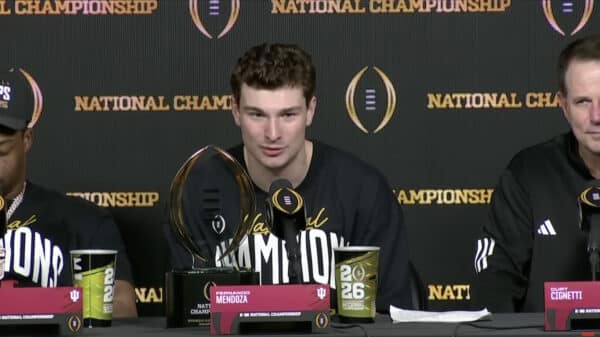
Last season, Indiana proved this point by showcasing the nation’s third-highest scoring offense, propelling themselves to a historic College Football Playoff National Championship. They weren’t alone; seven teams made it to the CFP while also ranking in the top 32 in scoring for 2025.
While consistent scoring doesn’t guarantee victory, an offensive unit that can generate points at will gives teams a crucial advantage in an ever-competitive landscape. As the 2026 recruiting and transfer portal cycle wraps up, certain teams appear primed to excel in scoring next season.
Here’s a look at the college football teams expected to feature the most explosive offenses in 2026:

1. Texas
Texas has fortified its offense by bringing in Auburn wide receiver Cam Coleman, along with running backs Hollywood Smothers (NC State) and Raleek Brown (Arizona State). These new additions should significantly amplify their scoring potential for 2026.
Arch Manning recently showcased the best moment of his career by outplaying Michigan’s Bryce Underwood in the Citrus Bowl. This impressive postseason performance may signal a turning point in his growth. If Manning continues to improve, the Texas offense might reach heights comparable to the peak moments of the Sarkisian era, which already includes back-to-back CFP semifinal appearances.
As is true for elite teams on the verge of greatness heading into 2026, the foundation is laid up front for Texas. The Longhorns have added several highly-regarded players via the transfer portal, setting the stage for success, but only if Manning has the necessary protection. With a strong line of scrimmage, this SEC powerhouse can put immense pressure on opposing defenses aided by a skilled play-caller in Steve Sarkisian and Manning’s rapid ascent.
2. Miami
Despite experiencing the loss of four key starters on the offensive line, Miami is positioned to maintain its track record for explosive plays and quick scoring next season. The arrival of Duke transfer quarterback Darian Mensah, alongside his top target Cooper Barkate and former South Carolina slot receiver Vandrevius Jacobs, could provide crucial versatility and lessen the pressure on Malachi Toney.
Toney dramatically increased his role during his freshman year, setting a single-season program record with 109 receptions.
The return of veteran running backs Mark Fletcher Jr. and Jordan Lyle also strengthens the offense. Notably, Fletcher posted three 100-yard games in the last four matchups, while Lyle dealt with injuries.
Looking ahead, Mario Cristobal’s offensive line might include outstanding players like Matthew McCoy, Samson Okunlola, SJ Alofaituli, Jamal Meriweather, and five-star freshman tackle Jackson Cantwell — recognized as the second overall prospect in the 2026 class. If this line can replicate their 2025 dominance, Miami’s offense could prove uncontainable.
3. Indiana
After leading the Big Ten in offense for the last two seasons, Indiana enters the season with high expectations, especially under Curt Cignetti’s leadership in his third year. Fresh from a national championship, the team faces the challenge of replacing a Heisman Trophy-winning quarterback, along with their top two running backs and leading receivers Elijah Sarratt and Omar Cooper Jr.
However, Indiana has built a strong foundation capable of weathering this level of turnover. Their track record reflects robust player development and effective scheme implementation.
Cignetti has selected TCU transfer Josh Hoover to replace Fernando Mendoza. Boston College transfer Turbo Richard brings explosiveness to the run game, and Michigan State’s Nick Marsh alongside Tulane’s Shazz Preston join Charlie Becker to revitalize the receiving unit.
The mentality and performance level up front are expected to remain unchanged. The Hoosiers’ ability to maintain their effectiveness will largely depend on their line of scrimmage.
4. Ohio State
Ryan Day’s decision to engage former NFL coach Arthur Smith as offensive coordinator has sparked varied reactions, particularly regarding Smith’s previous results in the professional realm. Nonetheless, the dynamics of college football provide a different context, especially for elite programs with the talent to dominate. This environment may allow Smith to thrive.
At Ohio State, Smith is likely to adopt a simplified, run-focused strategy while orchestrating strategic downfield opportunities for Jeremiah Smith and his peers. Quarterback Julian Sayin was among the nation’s most efficient passers as a redshirt freshman, with high expectations for improvement on the horizon.
Despite losses via the transfer portal at wide receiver, Ohio State remains stacked at the position, bolstered by five-star recruits Chris Henry Jr. and Jerquaden Guilford. Projected starters include Smith, Devin McCuin, and Brandon Innis, with Bo Jackson returning as tailback.
Solidifying the offensive line rotation must be a priority this offseason. Day has stressed the need to deploy at least eight versatile linemen, emphasizing depth and adaptability as key elements.

5. Oregon
No program boasts a better quarterback situation than the Ducks, thanks to Dante Moore’s decision to forgo the 2026 NFL Draft and return to school. Nebraska transfer Dylan Raiola provides additional depth, supported by promising talents Akili Smith Jr. and Brock Thomas. Freshmen Jordon Davison and Dierre Hill Jr. showcased their skills last season, eager to take on bigger roles next year.
While tight end Kenyon Sadiq is a notable offseason loss, projected to be selected in the first round, Jamari Johnson is set to take on that production. Dakorien Moore, Jeremiah McClellan, and Evan Stewart return as key options at wide receiver. Although there may be a slight statistical decline with elite offensive coordinator Will Stein moving to Kentucky, under Dan Lanning, Oregon’s offense has consistently proven challenging to stop.
6. Notre Dame
Next season will not have Jeremiyah Love or Jadarian Price stepping in during crucial moments, but Fighting Irish offensive coordinator Mike Denbrock remains unfazed. C.J. Carr rebounded impressively after experiencing an early setback in his career, finishing with 2,741 yards and 24 touchdowns, and ranking second nationally in yards per attempt at 9.4 with a passer rating of 168.06.
Running back Aneyas Williams is expected to take the first reps, although a committee approach may be necessary in 2026.
Ohio State transfers Mylan Graham and Quincy Porter join a talented group of pass-catchers, including Jaden Greathouse and Jordan Faison, who led the team in receptions and receiving yards as a junior.
Moreover, the offensive line remains a strength for Notre Dame, consistently well-coached and setting the tone in the trenches. With a favorable schedule ahead, expect significant offensive production throughout 2026.
7. LSU
Having secured the nation’s top-ranked transfer portal class, expectations for Lane Kiffin’s first year are sky-high, prioritizing immediate results.
With Arizona State quarterback Sam Leavitt joining the ranks, Kiffin also welcomed USC’s Husan Longstreet and completely revamped LSU’s receiving corps with 12 newcomers. The offensive line stands as a likely strength, anchored by five-star transfer Jordan Seaton. This unit needs improvement after inconsistent play last season, where the Tigers struggled at times to protect Garrett Nussmeier and meet high preseason expectations.
Tight end Trey’Dez Green is a proven playmaker, while Harlem Berry — the top running back in the 2025 recruiting cycle — chose to stay with the program to witness Kiffin’s vision take shape.
Kiffin achieved a quick offensive turnaround at Ole Miss characterized by impressive efficiency. He now aims to replicate that model in Baton Rouge, bringing along offensive coordinator Charlie Weis Jr. and key staff members.
8. Texas Tech
Texas Tech’s CFP shutout loss to Oregon left a bitter reminder of their offensive struggles, an experience that set the stage for their offseason narrative. Coach Joey McGuire promptly addressed those offensive needs during the transfer portal cycle, securing Cincinnati quarterback Brendan Sorsby along with four wide receivers from Power Four programs. With another solid transfer class, Texas Tech is in a prime position to contend for a Big 12 championship and a playoff berth—if their offense can perform, especially with some personnel losses on defense. In 2025, the Red Raiders often relied on their defense to make pivotal plays, a privilege they may lack next fall.
Optimism is bolstered by a strong backfield featuring returning players Cameron Dickey, J’Koby Williams, and Quinten Joyner, who are expected to be integral to the offense’s success next season.
9. Ole Miss
With quarterback Trinidad Chambliss granted an injunction for a sixth season, the Rebels look formidable entering 2026. Once an insurance policy, Auburn transfer Deuce Knight transforms into a luxury asset after Chambliss’s court resolution. Keeping college football’s most dynamic running back is crucial after Kewan Lacy opted to stay with the Rebels despite interest from LSU and Kiffin, having already rushed for 1,400 yards and an SEC-leading 23 touchdowns last fall.
10. Oklahoma State
Eric Morris led North Texas with the nation’s top total offense (512 yards per game) and scoring average (45.1 points) last year. Transitioning from the Group of Six to Power Four presents unique challenges, but Morris’s system has proven effective and he successfully attracted his two best players from North Texas to join him.
Oklahoma State is well-positioned to emerge as college football’s most improved team, thanks to Morris and a top-10 transfer class highlighted by quarterback Drew Mestemaker and tailback Caleb Hawkins. Expect multiple high-scoring Big 12 shootouts, showcasing impressive fireworks and exceptional offensive talent throughout the season.